

Components of Mechanical Seal
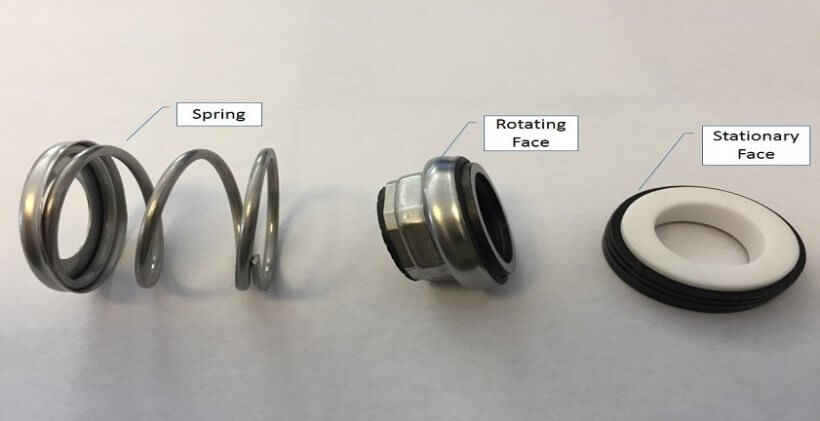
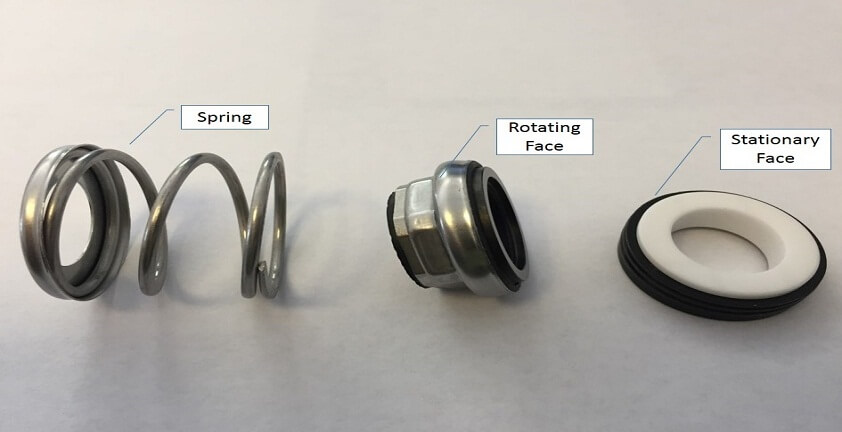
The components of a mechanical seal include:
- Stationary Part: A smooth and polished surface installed inside the pump casing.
- Rotating Part: A smooth and polished surface mounted on the pump shaft.
- Spring: Usually made of stainless steel, it connects the stationary and rotating surfaces to ensure effective sealing.
- Elastomeric Ring (O-Ring)
What is a Mechanical Seal?
A mechanical seal is used to prevent the leakage of liquids or gases between different spaces and between two mechanical components. These seals are typically made from various materials such as polymers, metals, or composite materials.
This method is widely recognized in almost all industrial sectors, and wherever a rotating shaft exists, some form of sealing is required.
Introduction to Types of Mechanical Seals
Mechanical seals vary in design, arrangement of components, and the mechanism for dissipating forces applied to the sealing surfaces.
Here are several common types of mechanical seals:
- Wave Spring Seals
- Single-Stage and Double-Stage Cartridge Seals
- Bellows Seals
- Auxiliary Systems and Supporting Equipment for Mechanical Seals
- Single-Spring and Multi-Spring Seals
Principles and Fundamentals of Mechanical Seal Operation
The stationary part (stationary surface) of the mechanical seal is installed and connected inside the casing, while the rotating part (rotating surface) is mounted on the pump shaft.
These components function in a way that creates a sealing space within the pump, preventing the leakage or escape of fluid from the pump chamber.
As shown in the diagram, the fluid is under pressure on the left side, and on the right side, the external space is at atmospheric pressure.
Between the stationary and rotating parts of the mechanical seal, a film of trapped fluid forms.
As the rotating part of the mechanical seal moves, this fluid film vaporizes, and the vapor itself creates the sealing space.
It is worth mentioning that when the pump is turned off, no pressure is generated, so no leakage occurs.
O-rings also contribute to sealing the pump. The O-rings mount the rotating part onto the shaft and the stationary part onto the casing, thus sealing the space between the rotating part and the shaft, as well as between the stationary part and the casing.