Fire-Fighting pumps
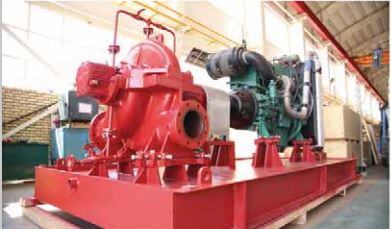
Fire pumps are used to supply water with the right pressure to extinguish a fire. These pumps play a vital role in firefighting systems, as they ensure that water is delivered to the fire scene in sufficient quantity and at the right pressure.
Types of fire pumps
Centrifugal pumps
Single stage: These types of pumps are designed for medium pressures and high flow rates and are used in small to medium fire extinguishing systems.
Multistage: These pumps have multiple impellers that are installed in series to produce higher pressure. They are suitable for tall buildings and industrial applications.
Positive displacement pumps
Piston pumps: suitable for very high pressures and low flow rates. They are used in special systems that require very high pressure.
Diaphragm pumps: less common, but used in special situations such as moving corrosive liquids or containing solid particles.
Submersible pumps: These pumps are submerged in water and are used to supply water from underground sources or tanks.
Principles of operation of fire pumps
Centrifugal pumps
Centrifugal pumps create centrifugal force with the rapid rotation of the impellers and direct the water towards the pump outlet. These pumps are suitable for providing constant pressure and high flow rate.
Positive displacement pumps
These pumps work by moving a certain volume of water in each cycle. Piston and diaphragm pumps are examples of this type that are used to generate very high pressures.
Applications
Sprinkler systems: water supply for automatic sprinkler systems that are activated in case of fire.
Hydrant networks: water supply for hydrants (fire hydrants) used by firefighters.
High-rise building water supply: high-pressure water supply for the upper floors of buildings.
Fixed Fire Extinguishing Systems: Support for fixed systems such as sprinklers, foams and sprinkler systems.
Features and benefits
High pressure: the ability to generate high pressure to deliver water to great heights or long distances.
Stability and reliability: robust design and stable performance in emergency situations.
High response speed: the ability to start working quickly to supply water in the shortest possible time.
Choosing a fire pump
Pump capacity: choosing a pump with a suitable capacity to meet the needs of the fire extinguishing system.
Operating Pressure: Ensuring that the pump can provide the required pressure for the fire extinguishing systems.
Water Source: Consider the type and location of the water source (eg, reservoirs, wells, or surface sources).
Energy consumption: pump efficiency and its energy consumption.
Maintenance and care
Periodic inspections: check the functional and mechanical condition of the pump regularly.
Operational Tests: Ensure proper pump operation by conducting regular operational tests.
Preventive maintenance: replacing worn parts and performing periodic services to prevent sudden breakdowns.
Standby: ensuring the pump is ready to work at all times, with batteries fully charged and diesel engines fueled.
Due to their high importance in protecting life and property, fire pumps need special attention in design, selection and maintenance. Correct selection and proper maintenance of these pumps can prevent irreparable damage in emergency situations.